Physical board
existing visual structure and routines
 Industrial AI for existing production.
BROWNFIELD SHOPFLOOR DATA
Keep the analog board. Make it digitally usable. Lean Boards Digital adds a structured data layer to existing visual shopfloor routines without treating the board itself as the problem.
THE INDUSTRIAL PROBLEM
Analog boards carry information that works well in daily operations but is difficult to historize across shifts, changes or aggregation. Lean Boards Digital adds structured states, history and usable information instead of forcing duplicate data entry.
WHAT IS OBSERVED?
The analysis starts from existing data and process information. Inputs are named, not guessed.
existing visual structure and routines
domain-defined fields, areas and relevant states
versioned states across shifts and points in time
differences between successive states
line, board, timestamp and relevant process context
ANALYSIS
The method remains traceable: deterministic steps first, additional models only where they make domain sense.
clearly define the relevant fields, areas and states from a domain perspective.
map the state relevant to the use case into a comparable data structure.
version states and make them traceable over time.
show changes as a diff between defined states.
provide structured information, for example as JSON/API, for downstream use.
OUTPUT
Results should prepare a decision, not pretend to make it.
The illustration shows the brownfield logic: Board State → History → Change → Structured Information.
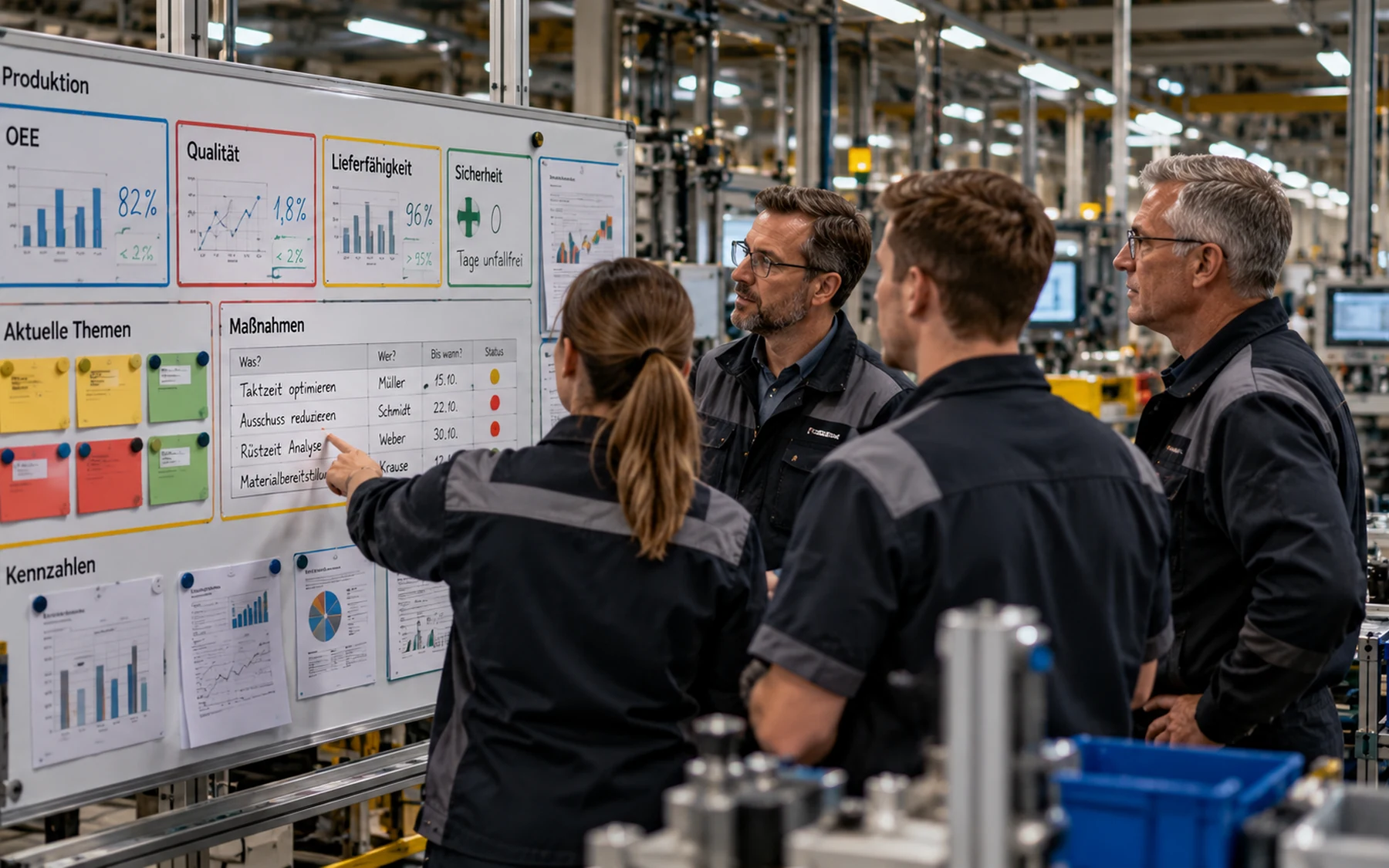 PHYSICAL BOARD
DEMONSTRATOR — EXAMPLE USE
The demonstrator shows how structured states of an existing board can be historized, compared and made usable for downstream systems.
Desktop demonstrator with fictional sample data. The states are shown only to illustrate possible use.
WHAT HAPPENS AFTER SUBMISSION?
We review the board structure, routine and target state and delimit the relevant question.
We propose which information should be made usable in structured form and how it can be reused.
Pilot scope remains deliberately limited. Expansion only after the value has been validated.
Lean entry without ERP/MES intervention or system rebuild.
Existing boards and routines remain in place.
Only the information relevant to the specific use case.
Strukturierte, nutzbare Auswertungen statt isolierter Einzelstände.
FINDINGS / LIMITS
The strength of the conclusion ends where data, model assumptions or process evidence end.
Fields, areas and relevant states must be clearly defined from a domain perspective.
Changes must be traceable and consistently maintained in the real process.
History and comparison require a defined baseline.
Not every visual item needs or should be structured.
Critical states or derived conclusions may require domain review.
Output and granularity depend on the concrete use case.
VALIDATION
A pilot starts with a real board and a clearly scoped question. The board structure, relevant information fields, existing routines, desired history and later use of the structured data are reviewed. Only then is the appropriate technical operating mode decided.
The Process Check structures the problem, process, data situation and constraints. A pilot follows only when the question is robustly scoped.